
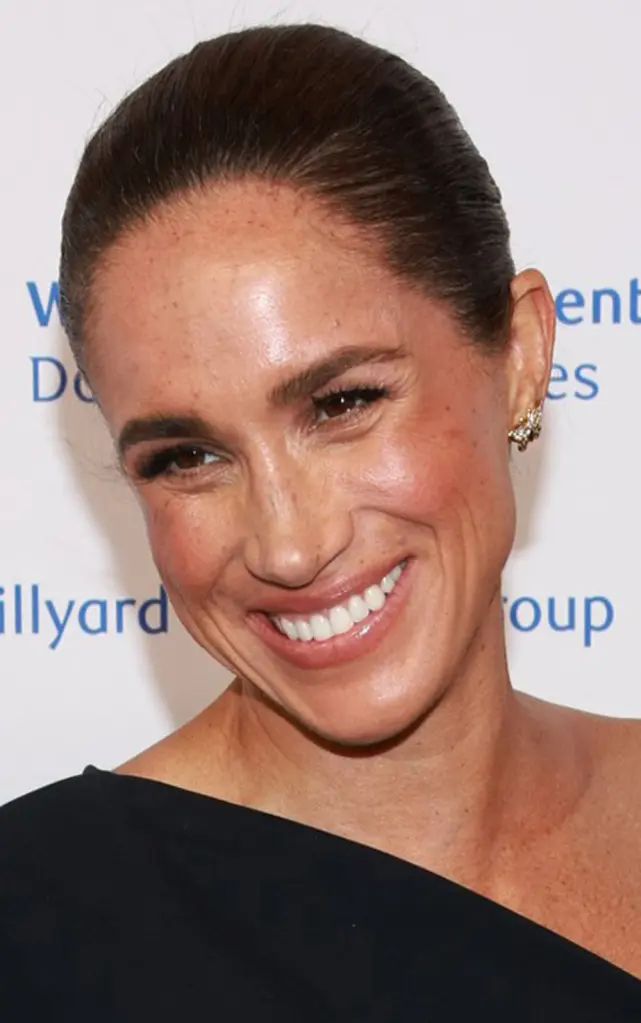
Jewellery has a remarkable ability to carry a story from one generation to another. Few recent examples illustrate that quite as beautifully as the diamond and sapphire earrings worn by Meghan, Duchess of Sussex, during a rare public appearance with Prince Harry in Canada.
Attending the David Foster Foundation’s 40th Anniversary Celebration in British Columbia, Meghan chose an elegant black evening gown accompanied by relatively restrained jewellery. Yet the earrings immediately attracted attention for a reason beyond their appearance: they once belonged to Diana, Princess of Wales.
Jewellery With a Personal History
The diamond and sapphire earrings provided a particularly meaningful element to Meghan’s otherwise minimalist evening look.
Rather than choosing jewellery purely for scale or visual impact, she wore pieces carrying a direct connection to her husband’s mother. Princess Diana’s jewellery remains among the most recognisable and closely followed collections of personal jewellery in modern history, and pieces associated with her invariably attract considerable attention when they reappear.
On this occasion, the earrings were worn with a floor-length black gown by Canadian designer Greta Constantine. Meghan completed the look with a fine gold bracelet and delicate ring, while Prince Harry wore a traditional black tuxedo.
The result demonstrated an enduring principle of good jewellery styling: an important jewel does not necessarily need other statement pieces competing with it.
Why Sapphires and Diamonds Work So Well Together
The combination of sapphire and diamond has been used in fine jewellery for generations, and with good reason.
A fine blue sapphire provides intense colour while diamonds introduce brilliance and contrast. Against white precious metal, the effect can be particularly striking, although sapphires are equally beautiful when combined with yellow gold.
Sapphire is one of the classic precious gemstones. A variety of the mineral corundum, it is naturally associated most strongly with blue, although sapphires occur in numerous colours.
Diamonds provide an ideal visual counterpoint. Their brilliance draws light around the coloured gemstone without overwhelming its colour, which is why diamond-set sapphire rings, earrings and pendants have remained popular despite changing fashions.
It is a combination that can feel traditional without appearing old-fashioned.
The Enduring Influence of Princess Diana’s Jewellery
Princess Diana had an extraordinary influence on jewellery fashion, and that influence has continued long after her death.
Perhaps the most famous example is her sapphire and diamond engagement ring, now worn by Catherine, Princess of Wales. Its large oval blue sapphire surrounded by diamonds helped establish one of the most instantly recognisable engagement-ring styles of the modern era.
But Diana’s jewellery wardrobe extended considerably further.
Pearls, coloured gemstones, diamonds and distinctive earrings frequently formed part of her public appearance. Importantly, she was also prepared to reinterpret jewellery rather than treating it as something that could only be worn in one prescribed way.
That attitude feels remarkably contemporary.
Modern jewellery customers increasingly expect fine jewellery to be wearable rather than reserved indefinitely for formal occasions. An important ring or pair of earrings can accompany an evening dress, but it can equally become part of a much less formal wardrobe.
When Jewellery Becomes an Heirloom
There is another reason this particular appearance resonates.
Fine jewellery is unusual among luxury purchases because it can survive its original owner almost unchanged.
Clothing inevitably wears. Technology becomes obsolete. Many expensive possessions gradually deteriorate or fall from fashion. A well-made piece of precious jewellery can instead pass from one generation to another for decades or even centuries.
Its financial value may matter, but its emotional value can eventually become considerably more important.
A diamond ring inherited from a grandmother, for example, may contain stones that could readily be replaced in purely material terms. What cannot be replaced is the connection between that particular ring and the person who once wore it.
That is the essence of heirloom jewellery.
Meghan’s decision to wear jewellery once owned by Diana demonstrates this very publicly, but exactly the same principle applies to jewellery within ordinary families.
Old Jewellery Can Have a New Life
Inherited jewellery does not necessarily have to remain exactly as it was originally made.
Sometimes preserving a piece intact is important because its design forms part of its history. In other cases, jewellery can be sensitively remodelled while retaining the gemstones or precious metal that give it sentimental significance.
An inherited diamond might become the centre stone of a new engagement ring. Several smaller diamonds from different pieces could be combined into an eternity-style ring. A gemstone from an outdated pendant might become a contemporary ring or pair of earrings.
This ability to transform jewellery is one of the great advantages of precious materials.
Gold and platinum can be reworked, while diamonds and many precious gemstones can potentially be removed, inspected and reset. A piece therefore does not necessarily reach the end of its useful life simply because its original design no longer suits the person who inherits it.
Instead, the next generation can become another chapter in its history.
Jewellery That Means More Than Its Carat Weight
The jewellery industry understandably talks about measurable qualities.
With diamonds we consider carat weight, colour, clarity and cut. With coloured gemstones we examine colour, origin, treatment, transparency and quality. Precious metals are described according to their fineness and weight.
These characteristics matter because they help establish quality and value.
But they cannot measure sentiment.
A modest diamond inherited from someone important may mean considerably more to its owner than a much larger stone purchased without that personal connection. This is one reason engagement rings and wedding rings acquire significance far beyond the intrinsic value of their materials.
The jewellery becomes associated with people, places and events.
Eventually, its story becomes inseparable from the object itself.
A Reminder of What Fine Jewellery Can Become
Celebrity jewellery inevitably attracts attention because of extraordinary gemstones, famous jewellery houses and spectacular valuations.
This appearance was different.
The significance of Meghan’s diamond and sapphire earrings was not primarily that they were expensive or rare. Their importance came from their history and the person who had previously worn them.
That makes the story particularly relevant to anyone choosing jewellery today.
An engagement ring purchased now may eventually be worn by somebody who has not yet been born. A wedding ring can become part of a family’s history. A diamond pendant given for an anniversary might one day remind another generation of the people who originally owned it.
Fashion changes continuously, but beautifully made jewellery has the potential to outlive those changes.
Princess Diana’s earrings appearing again almost three decades after her death provide a particularly visible example of something jewellers have always understood: the finest jewellery doesn’t simply retain precious stones.
It retains stories.